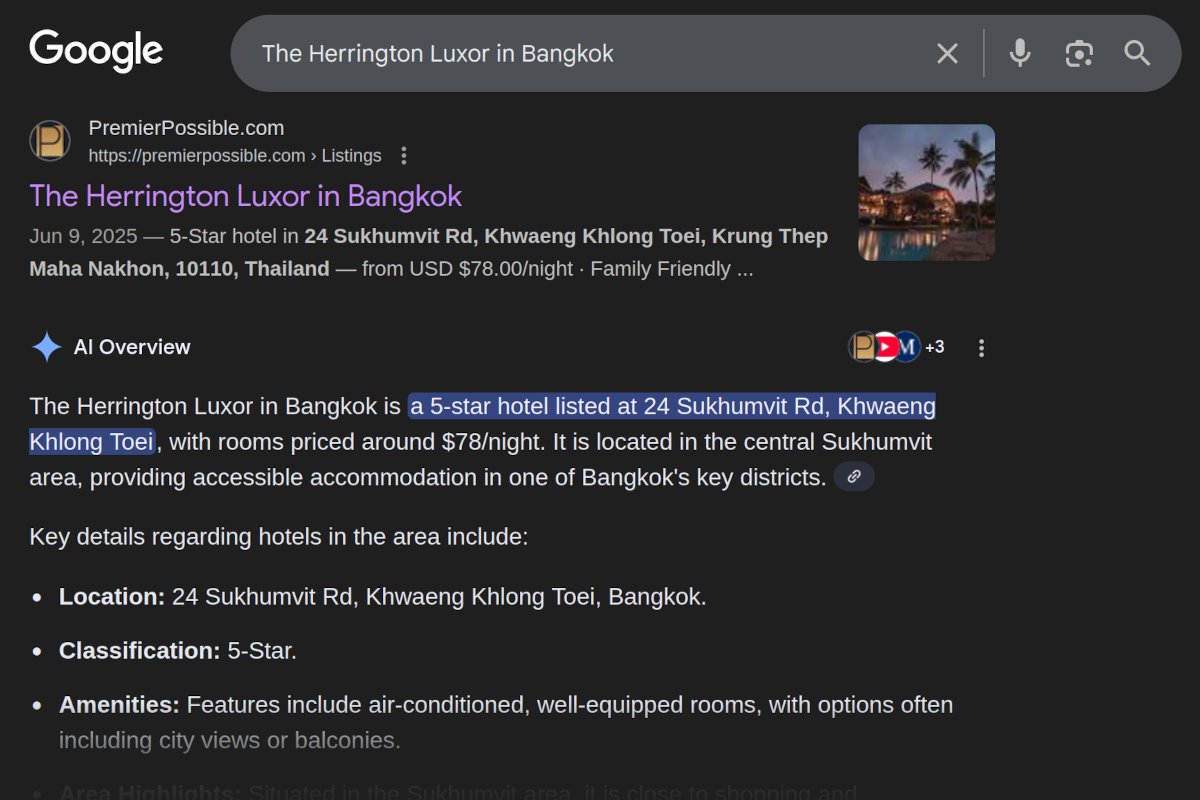
When you publish a listing on Premier Possible, you’re not just uploading photos and a description. Behind the scenes, each listing page also outputs structured data (JSON-LD)—a machine-readable summary of what the page is, what it offers, and how all the pieces connect.
Search engines and AI systems don’t “see” your page the way humans do. They infer meaning from text, layout, and links—but structured data removes guesswork by explicitly labeling key facts: this is a real estate listing, this is a hotel, this is the offer price range, these are the images, this is the location, and so on.
Google describes structured data as a way to help them understand the content of a page and enable enhanced search features when supported.
Below is a simplified (but real-world) view of how Premier Possible approaches structured data, how it differs between real estate listings vs hotel listings, and how it benefits agents, brokers, developers, hoteliers—and AI-driven search experiences.
What structured data is (in plain English)
Structured data is a block of JSON that lives in your page’s HTML and describes the page using shared vocabulary standards—primarily Schema.org.
Premier Possible uses the “graph” approach: instead of one messy blob, it publishes a set of linked “things” (nodes) that reference each other via @id. That matters because the page isn’t just “a listing”—it’s also:
- a WebPage
- published by an Organization
- with a primary image
- sometimes a video
- and a main entity (the listing object)
- with offers (sell / rent / nightly rates)
- and breadcrumbs for navigation context
These pieces come from Schema.org types like:
- WebPage / WebSite / Organization
- ImageObject / VideoObject
- BreadcrumbList
Premier Possible deliberately keeps this structured data aligned with what’s actually visible on the page, because Google’s structured data policies explicitly warn against misleading or spammy markup.
Premier Possible’s strategy: “Clear meaning, not gimmicks”
A common mistake in the listing world is treating structured data as a trick to force “rich results.” That can backfire.
Premier Possible focuses on:
- Accuracy: only markup facts the page truly supports (price, location, images, features).
- Completeness: provide enough context that machines can understand the listing without guessing.
- Safety: avoid structured-data patterns that trigger policy issues (fake ratings, hidden offers, irrelevant schema types).
And here’s a key reality check:
Structured data improves understanding—even when it doesn’t produce a “rich card.” Google only offers certain dedicated rich-result formats for certain content types (Product, Video, Vacation rental, etc.). Real estate “listing cards” aren’t always a guaranteed special format in Search Gallery-style features, but structured data still helps systems interpret and classify your pages.
Real Estate Listings: How the structured data is modeled
For real estate, the “main entity” is typically a RealEstateListing.
1) The listing is the container: RealEstateListing
The listing node expresses:
- listing title / description
- category (condo, apartment, villa, land, etc.)
- location (PostalAddress + optional GeoCoordinates)
- images (primary + gallery)
- publishing dates
- the actual offers attached to the listing
That’s the correct mental model: the listing is the page’s main entity, and the listing contains one or more offers.
2) The property itself: itemOffered
Inside the listing, itemOffered describes the underlying thing being sold/leased: often Apartment, House, or LandParcel (depending on the property category). Schema.org supports this pattern.
This is where Premier Possible puts “property facts”:
- bedrooms (QuantitativeValue)
- floor size (sqm / sqft mapped cleanly)
- geo coordinates (when available)
- lot size (when available)
- year built (when available)
- additionalProperty for structured “extras” (floor level, kitchens, parking, etc.)
3) Offers: where pricing becomes machine-readable
This is the part most platforms do poorly.
Most listing platforms do poorly here because their pricing is built for humans, not machines. They’ll show “From $2.9M”, “Starting at”, “Contact for price”, “Per month”, “Per night”, or even a formatted string like “$2.9M–$3.2M”, but then they either don’t output structured pricing at all, or they output it in a way that’s ambiguous or invalid for structured data (e.g., stuffing text into Offer.price, skipping currency, mixing multiple prices into one field, or using inconsistent “sale vs rent” signals). On top of that, many platforms treat multi-unit listings as a single item and only provide a vague summary—so search engines and AI systems can’t reliably infer the difference between one fixed-price property and a building with multiple unit types and a true price range. The result is structured data that looks “present” but isn’t trusted, verifiable, or machine-readable enough to be fully used by crawlers, validators, and AI search systems.
Premier Possible uses:
- Offer when there’s a single known price
- AggregateOffer when there’s a price range across multiple unit types
The businessFunction fix: use the GoodRelations values
Schema.org’s Offer.businessFunction expects values from the BusinessFunction enumeration, and Schema.org explicitly lists the commonly used values as GoodRelations IRIs (including http://purl.org/goodrelations/v1#Sell and ...#LeaseOut).
So instead of:
"businessFunction": "https://schema.org/Sell"Premier Possible should output (and your real estate snippet should default to):
"businessFunction": "http://purl.org/goodrelations/v1#Sell"For rentals/leases:
"businessFunction": "http://purl.org/goodrelations/v1#LeaseOut"That aligns with Schema.org’s documented “commonly used values.”
The big upgrade for developers & agents: unit-type offers (not just a price range)
If a development has multiple unit types, the best practice is:
- Keep AggregateOffer as the summary (low/high price)
- Include individual Offer objects for each unit type
Schema.org supports both Offer and AggregateOffer patterns.
Simplified example (real estate, multi-unit)
{
  "@type": "RealEstateListing",
  "name": "Luxury Penthouse Overlooking the Coast",
  "itemOffered": { "@type": "Apartment" },
  "offers": {
    "@type": "AggregateOffer",
    "priceCurrency": "USD",
    "lowPrice": 2900000,
    "highPrice": 3200000,
    "offerCount": 2,
    "businessFunction": "http://purl.org/goodrelations/v1#Sell",
    "offers": [
      {
        "@type": "Offer",
        "name": "3BR Type A",
        "price": 2900000,
        "priceCurrency": "USD",
        "businessFunction": "http://purl.org/goodrelations/v1#Sell",
        "itemOffered": {
          "@type": "Apartment",
          "numberOfBedrooms": { "@type": "QuantitativeValue", "value": 3 },
          "floorSize": { "@type": "QuantitativeValue", "value": 180, "unitCode": "MTK" }
        }
      },
      {
        "@type": "Offer",
        "name": "4BR Type B",
        "price": 3200000,
        "priceCurrency": "USD",
        "businessFunction": "http://purl.org/goodrelations/v1#Sell"
      }
    ]
  }
}
Important safety rule Premier Possible follows
If a unit type has unknown price:
- omit
priceandpriceCurrency - use
descriptionlike “Contact for price” - never put text inside
price(that creates invalid markup)
This is one of those small details that separates “markup that validates” from “markup that quietly breaks.”
Hotel Listings: structured data is modeled differently (and more granular)
Hotels are not “properties for sale.” They’re lodging businesses with bookable inventory (room types / rate plans). So Premier Possible treats hotel pages differently.
At a high level, hotel structured data commonly includes:
- the Hotel entity (business identity)
- address, geo, images
- amenities (when available)
- room/offer inventory (room types, rates, occupancy, sizes)
- pricing that can change by date and room type
Schema.org provides Hotel and related lodging types.
1) The hotel business: Hotel
A hotel listing typically centers on Hotel rather than RealEstateListing.
This is where you attach:
- brand/business identity signals
- address and geo
- site images
- “about” description
- amenities (often via LocationFeatureSpecification)
2) Room types and nightly prices: where hotels win with structured data
Hotel inventory is naturally multi-offer. Schema.org supports Offer with pricing models like UnitPriceSpecification (useful for “per night” logic).
Simplified example (hotel room offer)
{
  "@type": "Offer",
  "name": "Deluxe King Room",
  "businessFunction": "http://purl.org/goodrelations/v1#LeaseOut",
  "priceCurrency": "USD",
  "priceSpecification": {
    "@type": "UnitPriceSpecification",
    "price": 220,
    "priceCurrency": "USD",
    "unitText": "night"
  },
  "itemOffered": { "@type": "HotelRoom" }
}
The key difference versus real estate:
- real estate usually has “one-time sale price” or “monthly rent”
- hotels are “unit price per night,” often with multiple room types
Schema.org explicitly defines HotelRoom, Offer, and UnitPriceSpecification for these concepts.
Why this benefits agents, developers, and hoteliers
1) Better machine understanding → better matching
When the listing is clearly labeled as a RealEstateListing or Hotel (with structured offers, sizes, location, and media), search engines and AI assistants can:
- classify the page correctly (sale vs lease vs nightly)
- extract consistent facts (beds, size, address, price range)
- answer user questions more accurately (“Does it have parking?” “What’s the size?”)
This is exactly what structured data is meant to enable: clear, standardized meaning.
2) Stronger results in AI-driven search experiences
Even when AI systems don’t show “rich cards,” they still rely on structured signals during retrieval and summarization.
Structured data is basically “AI-ready context.”
- It reduces ambiguity (especially around prices and offers).
- It makes multi-unit developments and multi-room hotels easier to interpret.
- It helps AI assistants cite the right facts without hallucinating.
(That last part matters a lot as AI search becomes normal.)
3) Cleaner metadata across platforms
Many listing platforms publish:
- generic Open Graph tags
- inconsistent schema
- broken price formats
- or “one-size-fits-all” markup that ignores differences between real estate and hospitality
Premier Possible’s approach is intentionally split:
- Real estate pages emphasize property facts + sale/lease offers
- Hotel pages emphasize business identity + room inventory + nightly pricing
That separation is hard work—but it produces cleaner semantics.
What Premier Possible avoids (to protect rankings)
Google explicitly warns against structured data that is misleading, irrelevant, or violates policy—and those issues can trigger loss of eligibility for enhanced features or manual actions.
Premier Possible is designed to avoid common SEO landmines:
- No fake review markup (especially dangerous when copying ratings from third-party platforms like Expedia, Agoda, Hotels.com, or Trustpilot).
- No “Product” schema for things that aren’t products (real estate isn’t a retail product in Google’s rich-result ecosystem).
- No stuffing structured data with claims that aren’t visible on the page (a big policy risk).
- No invalid numeric fields like
"price": "Contact for price"(which breaks parsers).
The “invisible work” that makes it reliable
The structured data on Premier Possible pages isn’t just “a JSON template.” It’s carefully engineered to be robust:
- Canonical URL handling (avoids duplicate entity IDs and duplicate pages)
- Image deduplication (primary image + gallery without repeated URLs)
- Safe numeric parsing (prices and sizes normalized)
- Clean output (empty values removed so validators don’t choke)
- Graph linking (
@idanchors connect WebPage → Listing → ImageObject → Breadcrumbs)
This is the difference between “we have schema” and “our schema actually behaves at scale.”
Final takeaway
Premier Possible’s structured data is built to do one thing exceptionally well:
Make listings understandable to machines—search engines today, and AI assistants tomorrow—without risking policy violations.
- Real estate listings use RealEstateListing + itemOffered + Offer/AggregateOffer
- Hotel listings use Hotel + HotelRoom + Offer + UnitPriceSpecification
businessFunctionuses GoodRelations IRIs as Schema.org documents- Everything is designed to comply with Google’s structured data policies
What this ultimately means: when a listing is published on Premier Possible, it doesn’t just “look good” to humans—it becomes clean, consistent, and verifiable data that machines can trust. That trust is what improves discoverability over time: search engines can more confidently connect your page to the right intent (“for sale”, “for rent”, “per night”, “unit type”, “room type”), and AI systems can summarize and recommend listings with fewer misunderstandings. Just as importantly, Premier Possible avoids the shortcuts that cause structured data to backfire—like stuffing text into numeric properties, duplicating entities, or outputting inconsistent IDs—so your visibility isn’t built on something fragile.